Cajun Digital Marketing – Helping Local Businesses with Results-Driven Digital Solutions
At Cajun Digital Marketing, we help local service businesses grow their online presence, attract customers, and increase revenue (yes, make more money).
Local SEO
Local SEO improves your website’s visibility and rank in the search engine results pages for local searches. We start your Local SEO with Google’s free tool, Google Business Profile.
Google Business Profile (GBP)
GBP is a free tool that allows local businesses to appear in Google Search or Google Maps. Many businesses are still not using this opportunity to increase their visibility and rank higher in local searches. The aim is to be seen in the “local 3-pack” (the top three results shown for local searches with a map).
Do you want to know where your business ranks in the local 3-pack or map pack? Don’t miss out on this opportunity. Cajun Digital Marketing offers a free tool to Check your Google Business Profile ranking for your particular business.
This works for service-area businesses in specific geographical areas (no fixed location) or local businesses with a brick-and-mortar physical location. The goal is for your business to be found (visibility) when someone searches for:
- “Best [service] near me,”
- “[Service] in [city],”
- “[Service] in [neighborhood],”
- “[Product or service] open now near me,” etc.
These types of searches would include:
- “Coffee shop near me,”
- “Pharmacy near me,” or
- “Emergency plumber near me.”
How important are these searches? These kinds of searches are performed when someone is ready to buy. You miss customers who need your service or product if you don’t rank locally.
We offer numerous SEO services, Keyword Research, On-Page SEO, Off-Page SEO, Technical SEO, Analytics & Tracking to help your business succeed online.
Keyword Research – Digital Marketing
We start with Keyword Research. Why? Keyword research is the backbone, cornerstone, or foundation for any business’s SEO (Search Engine Optimization) strategy.
We use several SEO tools to do this. The purpose is to find and identify the ‘terms,’ ‘phrases,’ or ‘topics’ (or ‘keywords’) your potential customers are searching for on Google or Bing. This initial keyword research process is vital but doesn’t stop there. To stay competitive, you must monitor your keyword performance using analytics and refine your process when needed.
The keywords you identify are used throughout your website in content creation and architecture.
Why Keyword Research Matters:
When Keyword Research is done well, your website will better attract your target audience, improve your search engine ranking, and ultimately lead to higher conversion rates (turning website visitors into clients and customers).
On-Page SEO
On-page SEO refers to the techniques and optimization strategies applied directly to each page and its content on your website. These include meta tags, Title tags, meta descriptions, Anchor text, alt text, Internal linking, External linking, Content (using your Keywords to create high-quality and meaningful content, images, videos, and/or infographics for your website visitors), Responsive Design (mobile-friendly), and ongoing performance monitoring.
Why On-Page SEO Matters:
On-page SEO helps your website rank higher in search results by:
- Making your site easier to crawl and understand for search engines.
- Enhancing user experience, encouraging longer site visits and lower bounce rates.
- Targeting the right audience with content aligned to their search intent.
- Driving organic traffic, ultimately leading to higher conversions and business growth.
Investing in on-page SEO lays the foundation for a well-optimized website that attracts and retains users while building credibility with search engines. This is part of what will make your business grow online.
Off-Page SEO
Off-page SEO refers to things done outside your website (not on your page or site, but off your page) to improve your search engine rankings (SERPs), visibility, and site authority. These are the efforts to increase your website’s reputation, credibility, and trustworthiness. If someone lands on your website, will they trust you enough to get their Credit Card out to purchase your service or product? Your off-page efforts will greatly impact that possibility.
Your off-page SEO will improve if you can develop online connections with other bloggers and website owners. Also, by producing high-quality shareable content (or what some call linkable assets) in infographics, case studies, videos, images, or similar, you will encourage other site owners to link to your website.
A strong social media presence leads to additional backlinks, traffic, shares, likes, etc., which signals to Google that your site is essential and has quality content. This improves your chances of increasing your rank in the search engines.
Other components of off-page SEO are directory submissions and citations (NAP – name, address, and phone number) to and from reputable online sources. Some backlinks to your site are toxic, lowering its value in search engines and damaging your SEO efforts.
Why Off-Page SEO Matters:
- Improves Rankings: Backlinks and other off-page signals are among the top factors search engines use to rank websites.
- Increases Authority: Off-page SEO activities help establish your website as a credible and trusted source in your niche.
- Drives Referral Traffic: Backlinks from high-traffic websites can bring more visitors to your site.
- Enhances Brand Visibility: A robust off-page SEO strategy helps more people discover your website across different platforms and mediums.
Investing in off-page SEO is essential for building your online reputation and expanding your reach beyond the boundaries of your website. It complements your on-page efforts to create a holistic and effective SEO strategy.
Technical SEO
Technical SEO focuses on a website’s infrastructure or framework (many things which are not visible to someone landing on your website), but that are critical for search engines like Google to crawl and index your website’s content.
Technical SEO includes items such as your site’s robots.txt file, an XML sitemap, canonical tags, page speed enhancements (how quickly a site loads in the visitor’s browser), mobile optimization (mobile search optimization is Google’s search priority these days), HTTPS (a secure version of HTTP provides visitors safety while using the site), and schema markup and structured data (helps search engines better understand your content). These Technical SEO components (and others) provide search engines with important instructions and directions so your site will be indexed properly and displayed correctly in browsers such as Chrome, Bing, or Yahoo.
Why Technical SEO Matters:
- Improves Search Engine Crawling: Ensures search engines can efficiently find, access, and index your site.
- Boosts Rankings: Technical optimizations improve site speed, mobile-friendliness, and security, all ranking factors.
- Enhances User Experience: A technically optimized site is faster, more secure, and easier to navigate, keeping users engaged longer.
- Reduces Errors: Fixing technical issues prevents ranking drops and ensures consistent performance.
- Maximizes Visibility: Structured data and schema markup help your content stand out with rich snippets and other SERP features.
With solid technical SEO, you create a strong foundation for your website, enabling all your other SEO efforts to thrive and ensuring your site remains competitive in search engine rankings.
Analytics and Tracking – Google Analytics
Analytics and tracking must be part of any successful SEO strategy. What is not measured can’t be improved. You have to know where your visitors are coming from and how long they stay on your site (bounce rate and dwell time).
SERP or SERPs (Search Engine Results Page) are the results the browser returns to the searcher who is searching for something. What position is your site found, or is it even there in the SERPs?
Rank tracking monitors specific keywords to see how well your site and its content is performing over time. Are you using the right keywords that searchers use to find answers to their problems and questions? If you aren’t tracking and measuring that, then you can’t improve your site’s performance.
Google Analytics is a free tool that provides tracking of your site’s traffic sources, a user’s (searcher) behavior as they navigate your site, bounce rates, and conversion tracking (purchase, sign up for a newsletter, request more information).
Google Search Console is another free tool from Google that tracks a site’s search performance (impression, clicks, and ranking position). It provides data to show which pages are indexed (visible in search) and which pages are not indexed (not visible and why).
Why Analytics and Tracking Matter:
- Understand User Behavior: Gain insights into what works and what doesn’t to improve user experience and engagement.
- Measure ROI: Analytics help determine whether your SEO efforts are driving traffic, conversions, and revenue.
- Identify Opportunities: Uncover new keyword opportunities, content ideas, or areas for improvement.
- Monitor Progress: Track changes in rankings, traffic, and user behavior over time to ensure your strategy is on track.
- Troubleshoot Issues: Quickly identify and fix technical problems, indexing errors, or performance bottlenecks.
By investing in analytics and tracking, you gain the actionable insights needed to refine and improve your SEO strategy, increase rankings, and achieve your online goals. This will improve your visitor’s experience.
At Cajun Digital Marketing, we help small local businesses grow their online presence, attract more customers, and increase revenue (yes, make more money). We create customized, results-driven SEO and digital marketing strategies tailored to your budget, unique needs, and goals, ensuring measurable success in your local market.
Success Story: Pine Belt Pools
Thanks to our local digital marketing strategies, Pine Belt Pools began its swimming pool cleaning and pool maintenance service with a single 5-star review in December 2021 . See the next image.
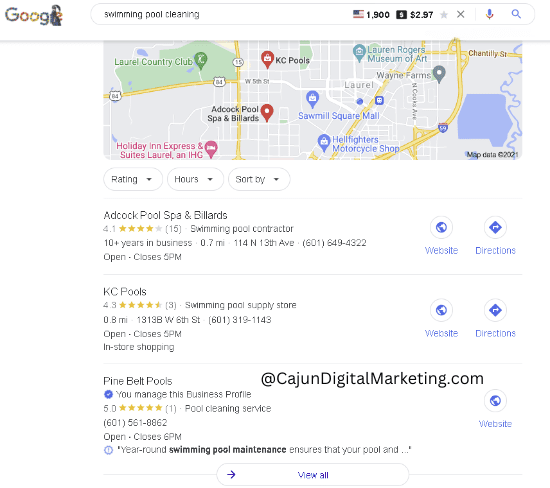
Pine Belt Pools appeared in the Google Map Pack in 3rd place at the time. Now, three years later, December 2024, Pine Belt Pools

Our Expertise: Supporting Local Service Businesses
We work with a wide range of local service businesses, including:
- Retail Businesses: From grocery and clothing stores to electronics and bookstores, we help retail shops improve their visibility and drive more foot traffic.
- Professional Services: Law firms, accountants, financial advisors, and consulting firms can count on us to grow their local presence and generate more qualified leads.
Whether you’re a real estate agency, a pharmacy, or any other type of local business, our tailored strategies will help you expand your reach and connect with more customers in your community.